Words Richard Hope
From deep in the Okanagan to Salt Spring Island, two women are defining what it means to make wine in British Columbia.
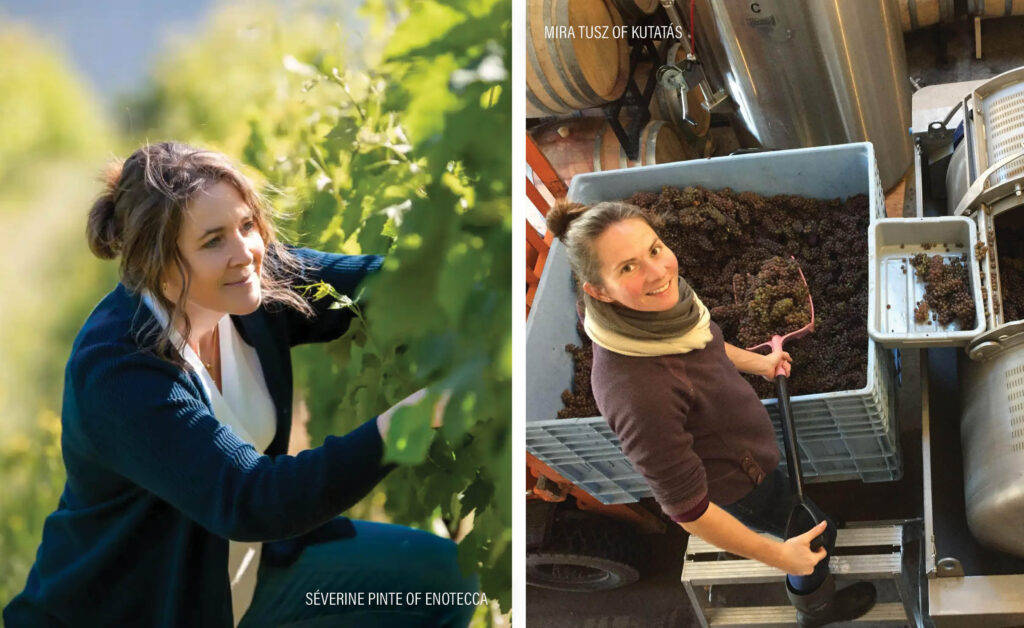
Each has distinct philosophies, yet both are pushing the boundaries of what this young region can achieve. I had the opportunity to meet with Séverine Pinte at Enotecca (home to La Stella and Le Vieux Pin), and Mira Tusz at Kutatás, to discuss the wine industry and its future.
Séverine arrived in B.C. via the cooperatives of southern France, where she spent over a decade managing large-scale production in the Languedoc. Trained in viticulture and enology at Montpellier, she watched the Okanagan transform during annual visits through the late 1990s and 2000s. As a young woman in France, she felt blocked from advancing in a traditional culture. “Here, I could take off.”
By 2010, she’d made the move permanent, becoming executive winemaker, viticulturist and managing partner at Le Vieux Pin and La Stella, overseeing nine vineyards spanning 25 kilometres across the Okanagan.
Mira took a completely different route. With a degree in microbiology, she found herself at Unsworth Vineyard during its establishment on Vancouver Island, where something clicked. “It was inspiring to see how careful and intensive viticulture translated into quality wines in the cellar.”
After pursuing a viticulture diploma through Washington State University and working cellar positions from Vancouver Island to New Zealand, Mira and partner Daniel Dragert launched Kutatás Wines in 2015, purchasing an eight-acre vineyard on Salt Spring Island in 2018. The name itself means “research” in Hungarian.
Wine Philosophy
Séverine’s approach is decidedly vineyard-first. Working with vineyard manager Jody Subotin, she spends extensive time in the field, tasting berries, assessing tannins and understanding how each vine captures nutrients from the soil. “I am truly honoured and respect the fact that without the soil and the vine, I wouldn’t be able to produce anything.” This terroir-driven philosophy guides her portfolio: French varietals at Le Vieux Pin and Italian expressions at La Stella.
Mira’s philosophy centres on constant exploration. Kutatás pushes boundaries with traditional-method sparkling wines, skin-contact orange wines, Austrian Zweigelt and German Ortega – all crafted using spontaneous indigenous yeast fermentation, whole-cluster fermentation and carbonic maceration.
Climate Change: Two Very Different Realities
In the Okanagan, Séverine battles extremes: the 2021 heat dome, polar vortex events in 2023 and 2024, and constant frost threats. Her response has been strategic adaptation – sustainable water management in a desert climate and relocating vulnerable varietals to protected sites. “We’re big gamblers as farmers. We just throw the dice every year.”
On Salt Spring Island, Mira sees a different story: “We have seen a general trend to warmer growing seasons, with a beneficial effect on fruit quality.” She notes that Pinot Noir quality, once achieved every three to four vintages in the early 2000s, is now “achieving on a yearly basis.”
Women in Wine: Progress and Persistence
Séverine appreciates B.C.’s more progressive environment while acknowledging persistent challenges. Recognized with France’s Knight Medal for Agricultural Merit (2023) and B.C.’s Leadership Excellence Award (2024), she’s increasingly vocal about her journey. “I’m hoping that by telling my story – the ups and the downs – other women will say OK, there’s hope, there’s a road forward.”
Mira sees steady progress, acknowledging that women remain “underrepresented in higher management, winemaking, and ownership positions globally,” but finds optimism in momentum: “The amount of successful women in the industry today is inspiring.”
BC’s Future: Diversity as Strength
Séverine sees terroir expression accelerating: “The terroir, the wines, the people – we’re doing fantastic things. I’ve seen an increase in quality in the last decade.”
Mira draws a compelling parallel: “Just as ‘French wines’ would not have a notable unifying characteristic … the B.C. wine regions vary so widely.” For the islands, she sees expansion ahead as wineries further south recognize the area’s potential “in a warming world for sustainable agriculture and premium Pinot Noir production.”
Despite their different approaches – Séverine’s classical elegance versus Mira’s experimental edge – both share a fundamental commitment to quality rooted in deep technical knowledge and respect for the vineyard.
Séverine captures it best: “Wine is something you feel in your taste buds but also inside. You taste wine surrounded by people you love, in a place you like – it creates memories that stay engraved in you. That’s the gift.”