Words Jesse Holth
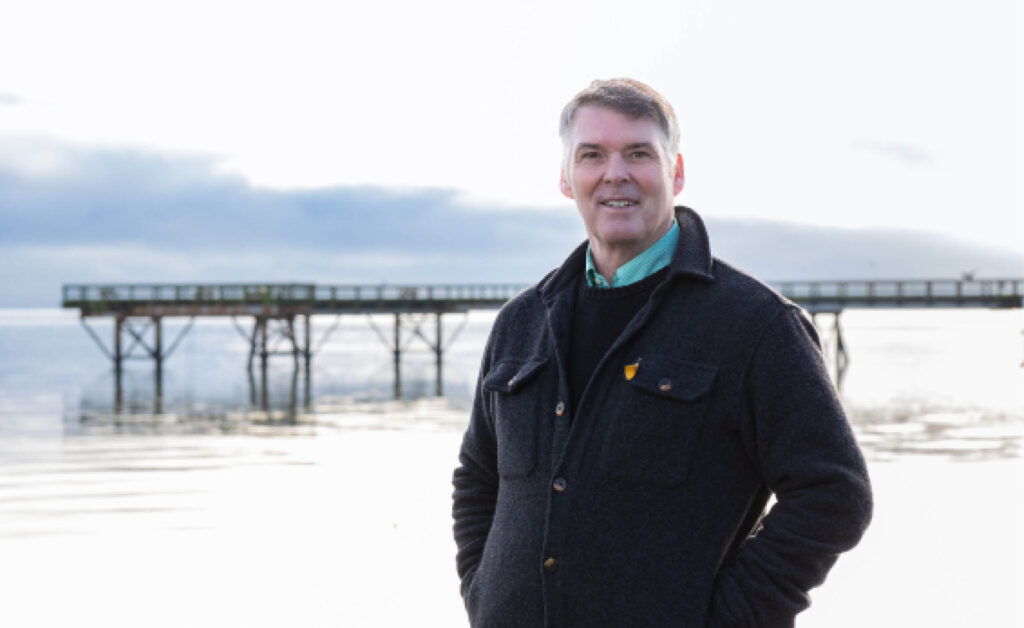
Photo Sarah Hartley Photography
Liam Edwards is the newly-appointed Chief Administrative Officer for the Town of Sidney. We chatted about local infrastructure, protecting our watersheds and reducing our ecological impact.
As Executive Director of Infrastructure and Finance for the Ministry of Municipal Affairs, you worked with every municipality in B.C. What lessons did you learn from connecting with communities both big and small?
Every community is driven by passionate people who want what’s best. While each community is unique, our similarities far outweigh our differences, most of which come down to scale. One size does not fit all is true, but neither is there a need to reinvent the wheel. Working with the smallest community in B.C., Zeballos, along with the largest, Vancouver, taught me that lessons flow both ways: I’ve seen small communities achieve remarkable things that larger ones struggle with. Ultimately, we are stronger when we stay connected, work together and reach out to one another when challenges arise.
You were previously the Chief Administrative Officer for Bowen Island Municipality, the only island municipality in B.C. What was that like?
Islands like Bowen are beautiful, remarkable places to live and work. But anyone who has lived on an island knows the old adage: an island is an argument surrounded by water. It’s a joke … but there’s truth in it. Islands attract a certain kind of person, and it’s that quirky, independent spirit that allows them to thrive. Bowen Island, as a municipality, is truly unique.
It is the only municipality that works with two regional governments – the Islands Trust and Metro Vancouver – yet it operates with complete independence, without shared services like those provided by the Capital Regional District. For example, on Bowen we ran the recreation services, the wastewater treatment plant, and seven different drinking water systems, each with their own distinct treatment system – in Sidney, the CRD manages those services. That independence gave me a deeper appreciation for the
full range of municipal services, many of which other municipalities never have to manage.
How does your background in adventure tourism inform your policies at the municipal level?
These experiences have helped me maintain a broader perspective on a wide range of issues. From 1992 to 2010, I worked in the adventure tourism sector, co-founding an adventure guide training company and operating my own sole proprietorship. My mentors in this field were truly inspirational, teaching me leadership skills that are hard to develop in a classroom or boardroom. I learned the value of building strong teams who you can implicitly trust. That business and leadership experience has proven invaluable in all the work I do.
In those early years, I spent countless nights in a tent in remote, far-flung places. Beyond the adventure, those experiences instilled in me a strong ecological ethos. With this came a question I still struggle with today. Recognizing that community growth and development are inevitable, how do we manage them while minimizing our impact? Theoretically, it seems like there’s a simple solution … practically, it’s extremely hard. That question led me back to university, where I earned a Bachelor of Science with a focus on water resource management. I came to believe that protecting water resources is one of the most effective ways to reduce our ecological footprint, and that focus has stayed with me throughout my career.
You are passionate about protecting our waterways. You said local government is the place to do this most effectively – can you explain?
Water management is a complex web of shared federal and provincial authority, with local governments having very limited direct control. However, what we do on the land typically runs off into a water system and often finds its way to the sea. Perhaps one of the largest pollution pathways to our oceans are rivers, streams and non-point source overland runoff. And local governments have significant control and influence over land use. Promoting and requiring proper land use management with watershed health in mind has tremendously positive impacts on the entire ecological system, not just our waterways.
Sidney is rooted in the sea – how will this connection inform your agenda for the town?
First, it’s important to clarify that Council sets the Town’s strategic priorities, and my role is to work with staff to implement them. Sidney Council values its heritage and strong connection to the sea, and while improvements can always be made, the Town has worked hard to protect the foreshore, expand public access, and leverage this remarkable asset. I hope we continue to build on that work and grow the “marine/blue economy” while minimizing impacts on the marine environment. We are also strengthening relationships with the W̱SÁNEĆ First Nations, who have lived here for millennia and whose connection to the land and sea runs far deeper than our own. I look forward to learning and sharing together as those relationships continue to grow.
You mentioned the town has been well-managed – noting that Sidney was built with an effective town hall, public works yard and water and wastewater infrastructure. But there is some aging infrastructure that needs to be replaced. Can you speak to this?
Most of Sidney’s infrastructure has been well managed over time. Much of the Town’s infrastructure is managed by a robust 20-year capital replacement plan, updated annually to ensure assets remain in good condition and are managed responsibly. However, the Town Hall and the Public Works Yard are nearing the end of their useful life, don’t meet accessibility requirements, and are under-capacity to meet functional needs now and into the future. These facilities require increasing and unsustainable costly maintenance and repair. Both the Hall and the Yard are critical to the successful delivery of Town services and the fiscally prudent path is renewal or replacement. Council has identified this issue in its Strategic Plan for several years, and we are preparing to begin public engagement early this year. While it is too soon to discuss costs, we know any solution will be significant, and we are actively exploring ways to minimize impacts and involve the community in the process.
You plan to bring a forward-looking lens to the role – what do you see for the future of Sidney?
Sidney, as an employer, has a strong culture and exceptionally capable team, and my goal is to make incremental improvements, so Sidney continues to attract and retain great people. By strengthening a culture of continuous improvement, support and service excellence, we become a stronger employer and deliver even better service to our residents and businesses. I believe that Sidney already provides excellent service, and I see that only improving over time.