

Words Jesse Holth
Photos Josh Holton
A seasoned traveller himself, Josh believes in leading by example – he has been across the U.S. and Canada, as well as the U.K., Ireland, Poland, France and Denmark. We chatted about the importance of accessibility, the intensity of professional sports, and how to confidently explore the world.
You were recently chosen to join the Danish National Development Team for Wheelchair Rugby. Congratulations! Can you tell us what this means?
It’s a huge opportunity to move to the next level in elite sport. It could allow me to continue my development as an athlete and be part of a team competing at the world stage, as well as continuing to learn from some of the best players in the world. Personally, I will get the opportunity to experience a new culture, a new language, and to travel and explore new things and experiences.
How did you first get involved with wheelchair sports?
From a young age, I have always enjoyed watching sports. I played wheelchair basketball as a young boy but found with my cerebral palsy that throwing the ball up to the basket to score wasn’t easy, and I was a bit discouraged. A fellow athlete who also played wheelchair rugby suggested I check that sport out. My mom took me to Vancouver to see an International tournament and from the first hit, I was hooked. Not sure my mom felt the same.
At the end of December, you’ll be moving to Denmark in order to train with the team – what are you looking forward to? What are some of the challenges?
I’m looking forward to experiencing a new culture and lifestyle in Denmark, being back to play with the team that I trained with, seeing family and maybe getting the opportunity to travel to other countries so close by. Some of the challenges will definitely be the language (I am hopeful that being immersed in it will mean it comes quicker), being far away from everything that I know and am comfortable with, as well as family.
Wheelchair rugby is a very unique sport – can you explain how it works?
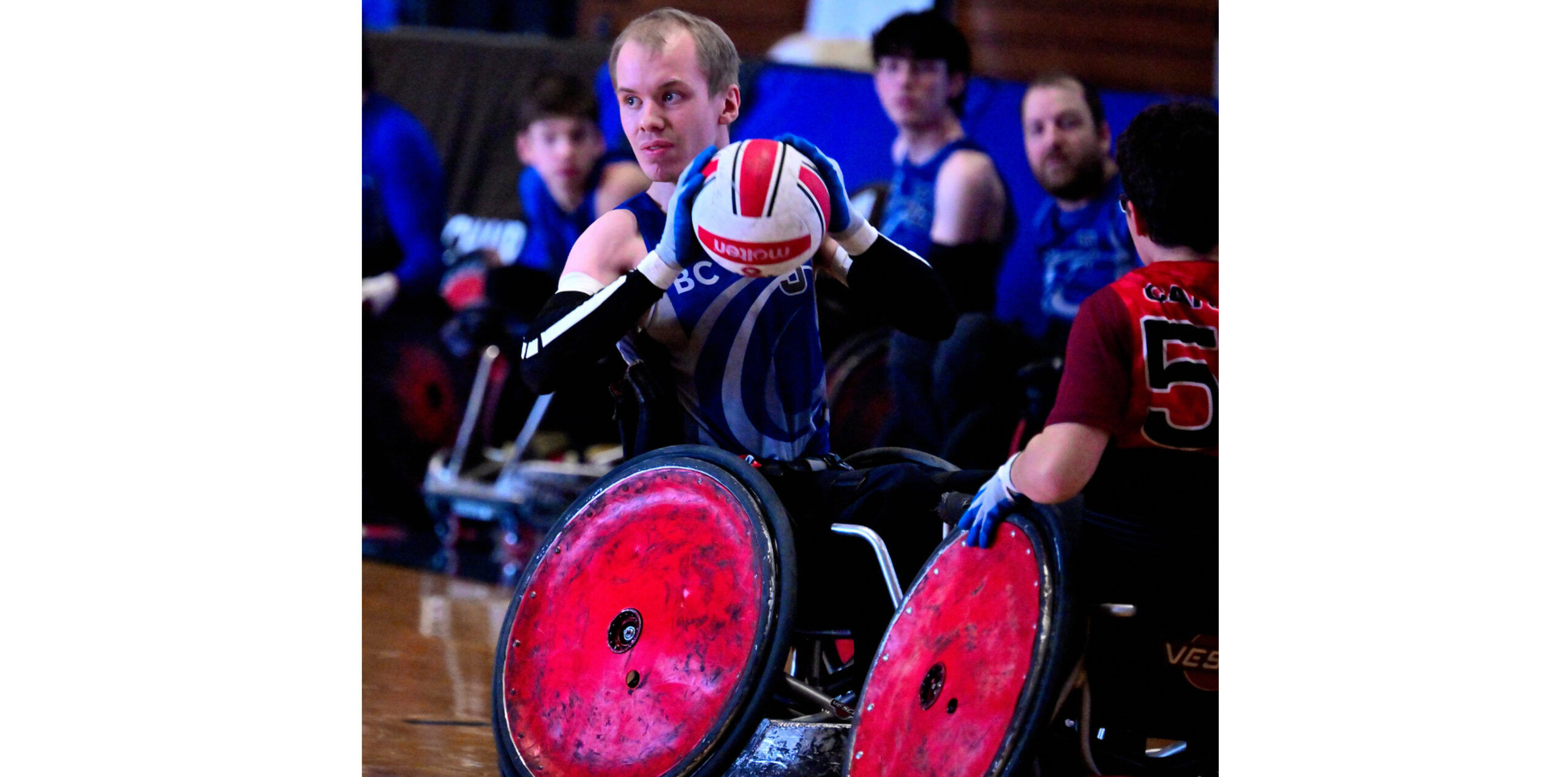
Originally started with the name murderball, it’s played on a basketball court – four vs four, with the objective of scoring across the opponent’s goal line. It is a full-contact game which combines elements of basketball, handball and hockey. The game itself plays four, eight-minute quarters, and teams have 40 seconds to score.
Players are all classified on their functional level of ability from 0.5 to 3.5 and the four players on the field of play cannot exceed 8.0, which makes teams play a mix of athletes with a range of function.
You said people are amazed when they watch wheelchair rugby and see players hitting each other at full speed – why do you think that is?
I think people don’t expect that level of intensity and high-power hits to happen. I can’t think of another wheelchair sport out there that has that intensity, and an athlete’s force to collide on purpose. I also believe that people think because we are in wheelchairs we are much more fragile. This definitely shows quite the opposite.
How would you define Accessible Travel?
Allowing people to experience travel regardless of requirements (wheelchair, walker, canes). Hotels, tour groups and organizations should try to take in consideration options that can accommodate everyone. We all want to see the world and are only looking for modifications. I realize not everything can be made that way, but with a little additional research and homework I think people can enjoy seeing the world. More often than not, if you reach out and talk to people, they will try to help you out.
What travel planning advice do you have for people in wheelchairs or with mobility issues?
Do your research and be flexible in some of your travel plans. Book early if you can, as there are limited rooms that are accessible. Call and talk – I find this is the best way to describe what you, as a traveller, need.
You mentioned a local school in Denmark where 25% of the population have disabilities – they provide adaptive swimming, sailing, fishing and other sports. How can we ensure accessibility is integrated into schools and other infrastructure?
I think this can be ensured by making it possible for everyone with or without a disability to take part, by assessing a person’s surroundings and requirements if they do not match the individual’s needs. We (people with disabilities) just want to participate, learn and be involved like everyone else. A school like this adapts the environment to the individual, removing the barriers, which is unique compared to the way it works here at home. In many cases, I probably would not have participated as it wasn’t adaptable or the school didn’t have the ability or equipment to make it possible. These schools do!
You said no one should feel limited as to what they can and can’t do – what would you say to people who want to explore the world but might be feeling a bit nervous?
Take it slow; don’t be afraid to try. As my mom has always told me, trying it might look different, sound different and move different, but your trip or experience is your own, which can happen if you’re open to it. It can be a reality.