Words Jesse Holth
Photo Sarah Hartley Photography
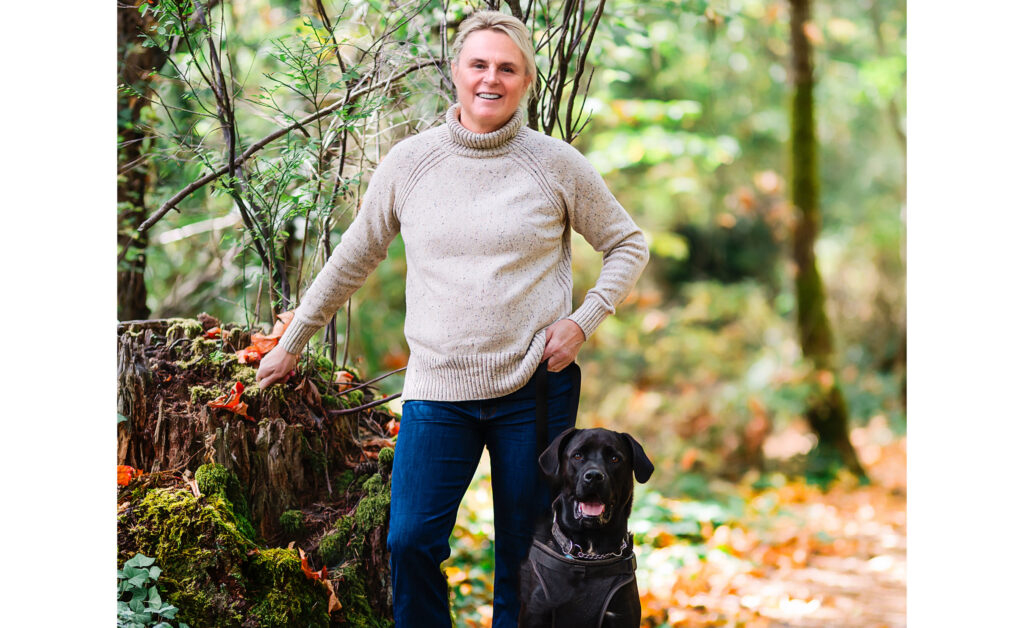
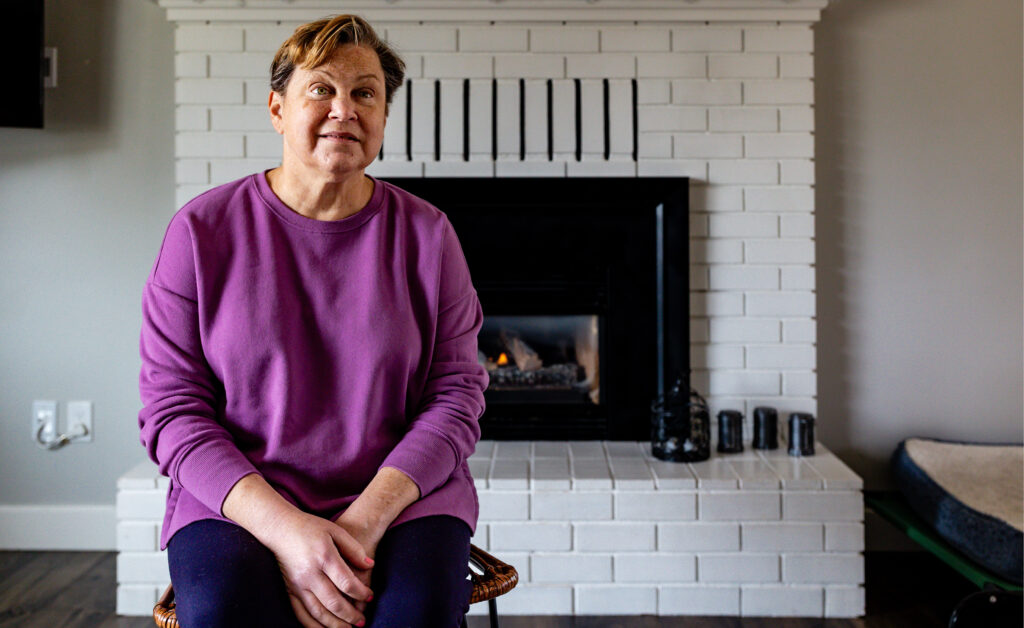
Tricia Pokorny is a Sidney resident and accessibility advocate who is searching for a living kidney donor.
We talked about the importance of accessibility, creating inclusive environments, and how to become a living donor.
Can you tell us a bit about yourself and your background?
I was diagnosed with Type 1 Diabetes (T1D) as I was turning three years old. At age 21, long-term complications caught up with me and took my sight completely. At the time, I was in my graduating year of the Fine Arts program, drove a car and could fully understand the concept of shape, movement and colours. Learning to live the “blind life” was an adjustment for myself, my friends and my family.
I began by getting involved with not-for-profit organizations where I was living in Ontario, as well as the university I was attending. I trained with my very first guide dog Bogey, and switched my degree to Linguistics. At graduation, Bogey was presented with a special medallion for his determination to get me back and forth to the university. It was a huge achievement, but we managed to do it.
One evening, friends and I went to opening night at the first casino in Niagara Falls, Ontario. I noticed that each time I rang the bell on my slot machine, nobody would come near me. I quickly realized that the staff was uncomfortable when having to assist or accommodate someone with a disability.
The next morning I sat down and wrote a business case to the president of the casino, requesting a meeting. I gave him my observations and feedback while strongly suggesting he consider mandatory sensitivity awareness training for staff, including the Board of Directors, and a full access audit on the premises. He called me back a couple of weeks later and asked me to join the team – I was ecstatic.
Two years after starting at the casino, I was recognized by the International Labour Organization of the United Nations in Geneva, Switzerland. The interest with UN delegates was incredible, and at that time, to our knowledge, we were the only casino in the world that was focusing on accessibility and diversity. I worked at the casino for 14 years while continuing to volunteer throughout the community. I also started working with the Ontario government to help in the creation of the Accessibility for Ontarians with Disabilities Act, 2005 (AODA).
In 2022, my partner, mother, and I sold everything and moved out to B.C. to be closer to my brother and his family. In June 2024, the university I graduated from bestowed upon me an Honorary Doctorate of Laws, for the accessibility work I pioneered in Ontario.
Knowing that Chronic Kidney Disease (CKD), another complication of T1D, was starting to take its toll on me, I was advised by my Nephrologist at Royal Jubilee Hospital that I was in stage four kidney disease, and should start looking for a living donor.
As an accessibility advocate, what are some of the tools you use to train staff members on creating inclusive environments?
The most important thing I tell everyone is to ask a person: “How can I help you?” Sometimes they will tell you they’re fine, and that’s OK, but sometimes they might take you up on your offer. If you don’t know how to help and they want your help, ask them: “What is the best way to help you?”
I direct everyone to the Canadian Standards Association on Barrier-free Design – these best practices provide a true guide to building accessibility in your space. Being able to give people detailed explanations of where things are located is especially important for individuals with sight loss blindness, our aging population, or individuals with cognitive difficulties.
Creating welcoming environments that are easy to access if someone is in a wheelchair or scooter, or uses sighted guide or a walker, allows all individuals to access stores, buildings and doctor’s offices. Don’t forget about the guide dogs, because they too are allowed in stores and restaurants by law.
Nobody should have to wave human rights legislation in front of you – rather, as a business owner, developer or builder, you should be planning to build accessibility right from the beginning, include all staff, hire staff with various abilities and let others know your commitment to making positive change in the community.
You currently work as a Program Lead for CNIB, and you’re on the advisory committee for BC Transit and the City of Victoria. How do you bring accessibility advocacy into these spaces?
At CNIB, everything we do revolves around accessibility. Our Come To Work program, technology, career outreach, guide dog program, and supports and services are for individuals who identify as having vision loss. We are also able to work with other employers in BC, to encourage them to hire someone through our Come To Work program. We do presentations to employers who want to learn, show them that accommodations are not as expensive as they think, and we work with them to make an inviting environment that is free of barriers and discrimination.
Fortunately, BC Transit and Victoria City Hall are advocates for accessibility, and our committees work as a team to change obstacles into opportunities. It is a continual work in progress, but both committees have made tremendous improvements and continue to look for changes that will assist in accessibility.
Regardless of age, we have to remember that our sidewalks need to be level, with curb cuts that have tactile walking surfaces for those with limited sight or no sight to properly and safely navigate the streets. We have a lot of aging seniors who rely on pathways with unsteady ground or uneven pavement – we lack safe and affordable neighbourhoods that won’t cause them harm, and open spaces that are conducive to all, including those with dementia and their support persons, those with autism, those in scooters, and guide dog partners.
Everyone is affected by disability, and it touches all of our lives – we need to do our best to make improvements to our cities.
You’re living with advanced chronic kidney disease and need a transplant. What are some of the misconceptions about being a living kidney donor? What is the recovery like for donors?
These are a few myths about living kidney donations from the Mayo Clinic. And of course, if anyone has further questions, please contact St. Paul’s Hospital in Vancouver. They have an amazing kidney transplant unit, and the staff and doctors are all incredible.
Myth: You must be related to someone to be a match. In fact, anyone can be a living kidney donor. You can consider donating a kidney to a relative, friend, acquaintance, or anonymously to someone on the waiting list. Donors and recipients are matched with other donors and recipients, creating what is known as a kidney chain.
Myth: Kidney donors can’t live an active lifestyle after donation. False: in most cases, kidney donors can return to normal activities four to six weeks after surgery. Most donors undergo a laparoscopic procedure that involves making a few small incisions instead of a larger one.
Myth: Donating a kidney shortens your lifespan. In truth, multiple studies have shown that donating a kidney does not shorten one’s lifespan. In fact, kidney donors tend to live longer than the general population.
To hear from a living kidney donor, you can watch Hot Dogs for Life, a 15-minute video about Skully White, an Abbotsford hot dog vendor who donated his kidney to a customer.
You said one thing people should understand is that they’re not giving up their life to accommodate yours – they’re giving up an organ, of which they have two, to help save your life. What else would you like people to know?
If I am blessed to receive a living kidney, I will be forever grateful to the donor, for allowing me a second chance at life. I’m looking forward to feeling healthy and taking the best care of a new kidney! I still have a lot I want to do, but don’t have the energy right now. I’d like that to change, so I can get out and enjoy the world!
To reach the living donor clinic at St. Paul’s Hospital in Vancouver, call: 604-806-9944.