
Words & Photos Rosalie Knogler
When I ask people if they’ve heard of home children, they often answer “no,” or mistakenly believe these were children evacuated in wartime.
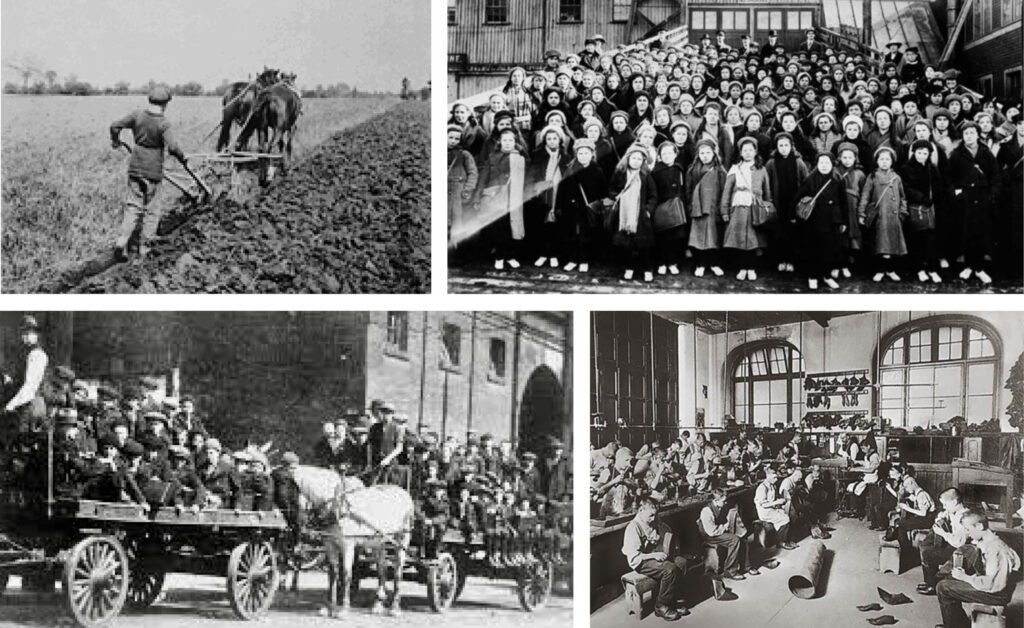
During Britain’s Industrial Revolution, people moved to cities, contributing to mass unemployment and housing shortages. Poverty, disease and cholera epidemics left 30,000 dead. The poor were often placed in terrible workhouses, their families split apart in Dickens-like scenarios.
Between 1869 and 1948, more than 100,000 children, youngsters to age 18, were sent to Canada as cheap labour. Only two percent were orphans. Others were sent, sometimes without parental permission, and many never saw their families again.
Approximately 10% of Canada’s population, four million people, are descendants. Prime Minister MacDonald’s Child Migration Scheme brought home children here. Fifty agencies, including Maria Rye, Annie McPherson, Catholic Emigration Society, and Fairbridge Farms received payment for each child. Barnardo’s sent 30,000 children … my orphan grandfather was one of them.
Thomas Barnardo, from Dublin, trained as a doctor in London. In 1867, he began a boy’s school with free basic education after finding many in dire straits. He opened a home for boys to live and do apprenticeships in 1870. Barnardo accepted children regardless of race, disability, or circumstance. They taught them boot-making, typesetting, tailoring, baking and carpentry. He later established residences and domestic training for girls.
My grandfather, at 13, arrived in 1902 with 200 boys and 100 girls on board ship. They called this the Golden Bridge to Canada. Many home children siblings were separated on arrival. Most children came to Ontario, but later all across Canada. Boys became indentured farm labourers, and girls domestic servants.
There was little oversight, with interviews often conducted in front of employers. Some children experienced beatings, overwork, starvation, rape or even death. An unmarked mass grave of home children was discovered in Etobicoke. Physical and emotional abuse was common, continuing throughout their lives because of society’s prejudice. In the book Anne of Green Gables, home children were called “London street Arabs.” Books, movies, songs and television programs tell their stories. There were some good outcomes, however, with even a few adoptions.
Halifax’s Pier 21 display for home children is a small write-up titled “Waifs and Strays” in a hidden alcove. Approximately 75 percent of these children experienced abuse or were treated like slaves, but the Canadian government appears embarrassed by this history. Even Canada House in London, England, ignores this.
In 2010, Canada Post issued a stamp during the Year of the Home Child. A motion before our Canadian Parliament asked for an apology in 2017, but still hasn’t been approved. Our Immigration Minister at the time, Jason Kenny, stated: “There is limited public interest for everything that’s ever been unfortunate or a tragic event in our history.” England has apologized.
Approximately 25,000 former home children fought in the two World Wars. Many lost their lives, and some received the Victoria Cross. A wreath was displayed at Victoria’s Remembrance Day. Most home children are deceased now.
Home Children Canada is a non-profit research organization helping families find their home child ancestors. Beacons of Light displays across Canada began in 2019, commemorating 150 years since the first home children arrived. September 28th is National British Home Child Day.
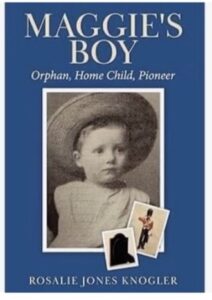 Maggie’s Boy, my epic tale of historical fiction based on facts, dates and people, spans over 100 years from 1874. It relates the history of Ireland, England and Canada in turbulent times: the Irish Troubles, the harsh Victorian era, home children, homesteading, deaths, the Spanish Flu, the “dirty 30s” and two world wars. It’s available from Amazon, Indigo, Barnes & Noble or email knogler@shaw.ca.