Words Jesse Holth & Bennett Gilleland
Photo Wind Gypsy Photography
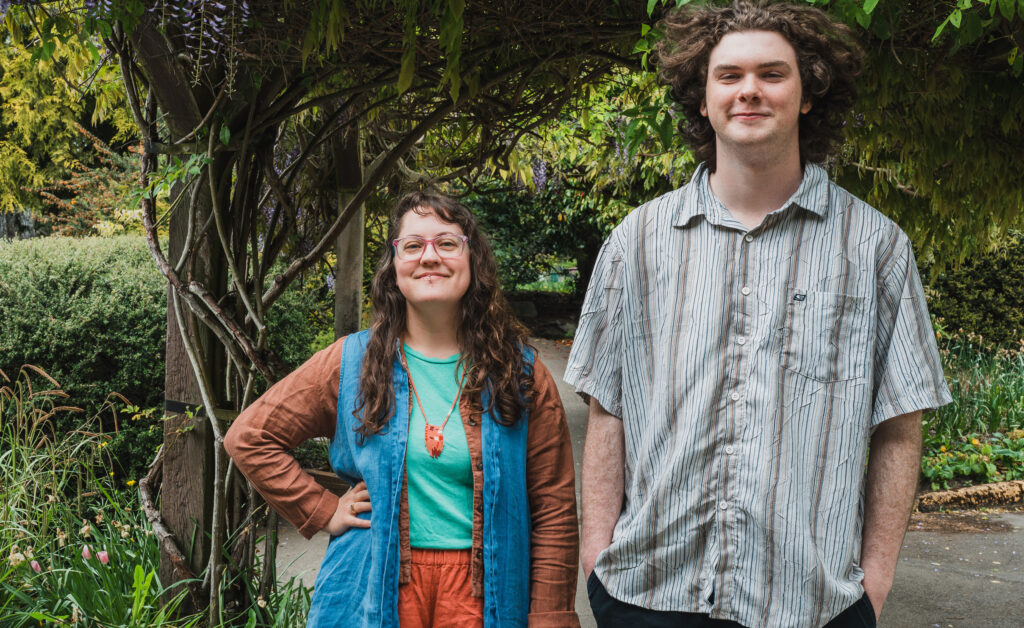
Jesse Holth and Bennett Gilleland have been named the Community Poet and Youth Community Poet for the District of Saanich.
How and when did you start writing?
Jesse: I have always been a writer – throughout childhood I was an avid reader and in high school I wrote songs and journaled a lot. I didn’t start writing poetry until my late 20s. I had studied poets like Emily Dickinson and Seamus Heaney at university, but never tried writing my own poems. It took years to feel comfortable calling myself a poet. For anyone starting out, I highly recommend reading as much poetry as you can get your hands on – you don’t need a fancy degree to write, you just need to read, read, read. Have fun and experiment with your own writing.
What are your plans as Community Poet?
Jesse: I’m looking forward to engaging with people on the many ways you can interact with poetry. I will be offering workshops, readings and other opportunities to connect. We’ll also be using the Little Free Libraries to promote poetry and invite people to participate. I would really like to convey two things: that everyone can enjoy poetry, and that anyone can be a poet. I think there is often a misconception that poetry is hard, or too formal, or not accessible. But one of the things I love about poetry is that there are no rules! A poem has 100 doors you can enter through – it’s about emotion and how people fundamentally connect.
Bennett: Aside from planning events, I hope to become more in tune with the community. Since finishing my degree, I’m looking back at how I’ve isolated myself in studying, and I need that to change. Being in any position that acts to represent a group, or a community, is a big undertaking, and I want to step up and be the person who can do that. I want to encourage, support and platform. At the end of the day, I don’t want this to be just a personal victory; I want everyone to benefit from a youth community poet, not just the youth community poet.
Tell us about your craft and your writing practice.
Bennett: Craft is all about the high. Better than getting published or performing. Just me and a desk. Writing pages and pages until “that” moment: the moment I write long enough to get the word, the line, that one paragraph. The one that gets me out of my desk, screaming, jumping, disturbing the neighbours. That moment of “I can’t believe I wrote that.” Everything about it just clicks and yet it feels like it took forever to get there. Craft is at its best when it’s like that one knuckle that won’t crack, but when it finally does, cover your ears.
Who are your favourite poets right now?
Jesse: This is an impossible question! I have so many favourite poets – I read a lot of poetry. Old and new, experimental and formal, prose poems and found poems. My taste is wide ranging, but some of the poets I’ve been enjoying recently are Jane Hirshfield, Mosab Abu Toha, Tracy K. Smith and Ilya Kaminsky. I’ve also been reading a lot of poetry in translation. I’m always impressed with how much talent is out there; I am constantly discovering new writers to love.
You started out in spoken word – what are some of the differences between written poetry and spoken word?
Bennett: They’re two sides to the same coin; the history of poetry is informed by page and oral presentation, but I think every page poet should try spoken word. The feedback is immediate (whether snapping, laughing or clapping). It’s an easy, organic way to find out what is working in your piece, what lines get the biggest response. Additionally, the way performance has improved my confidence is invaluable. Practicing speech eases many of life’s obstacles. Even if you’re not a poet, performing at an open mic is a safe and relaxed place to improve public speaking.
Where are your favourite places to write?
Jesse: Anywhere I feel connected – to the ocean, to other people, to the more-than-human world. I find inspiration among the trees, listening to birds, watching the sunset. Being around life and living things and feeling that sense of interconnectedness. I draw strength and creativity from community and ancestors. I believe place is reciprocal: we give to it, and it gives to us. It can sustain us. Some of the best advice I’ve gotten is that you are working on writing, even when you’re not. Even when you are just thinking or being in a space – that deep attention fuels your creative practice.
Your position has a focus on youth – how can we get more youth involved in poetry and why is it important?
Bennett: For the first time in history, we have eyes into everyone’s lives, and anybody can respond to it with their own unfiltered words. Poetry has been used throughout history to every facet of human joy and suffering, and now that this is a generation of limitless information, it makes sense that there’s potential for the most eclectic and honest types of poetry. Everyone wants to mention how growing up around the internet has ruined us, but it exposes us to a wealth of perspective. Our voices matter because we’ve seen too much; maybe we share too much. But we are conditioned for expression and poetry is built for that.
What projects are you currently working on?
Bennett: I’m working on my first collection of poetry. I don’t want to say too much about it, but it’s differed greatly from my past work. The core of it is an examination into queer history as far back as the earliest cave drawings. Most of the time I write poetry to get a better understanding of myself, but with this book I want to learn, teach, unpack and track the journey that queerness has taken and how it informs us now. I’ve never been more excited for a project.
Jesse: I am working on several full-length poetry collections. I have a large body of published work, and I’m in the challenging stage of building and organizing books around these pieces. One of the books is focused on themes around nature and history, lineage and reckoning. A friend described it as “ecofeminist” and I think that’s pretty accurate. I also have a collection of erasure poems and a book with darker themes around war, complicity, oppression and resistance. Poetry is about the not-knowing – trying to figure something out, questioning on the page. What is asking to be written? Trust that the work knows where it’s going. Trust in the process.