Words Jesse Holth
Photo Janis Jean
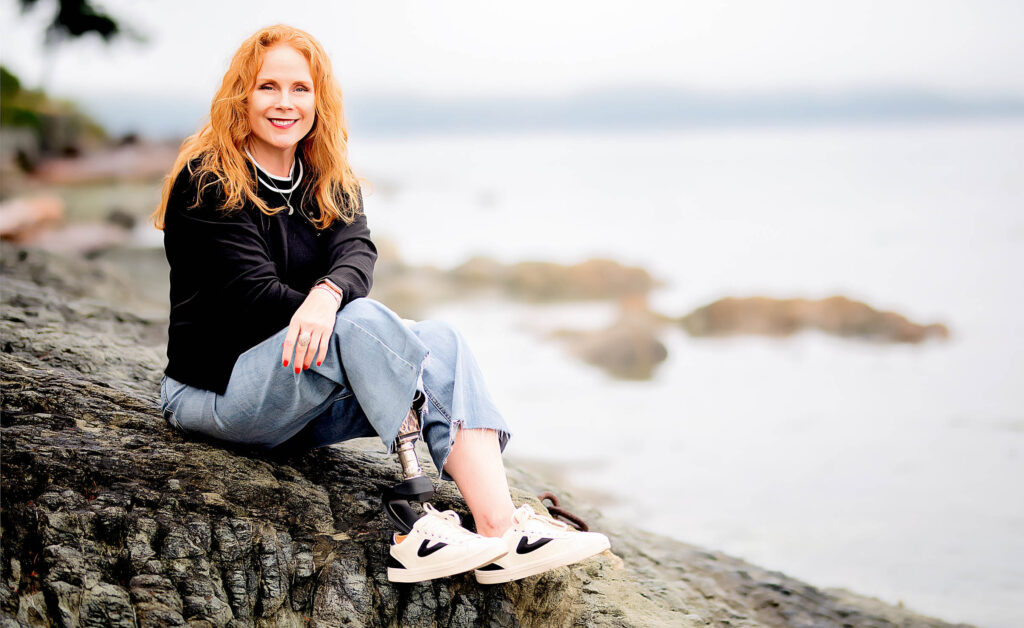
Laurie White is a former RCMP officer who was shot in the line of duty and had her leg amputated – we spoke about trauma, PTSD and resilience.
Can you tell us a bit about yourself and your background?
I spent my career in the RCMP – in policing, you spend a lot of time dealing with heavy, unpredictable moments, often witnessing the absolute worst of humankind. Carrying that weight takes a toll, but it also taught me ways to survive it. As a retired police officer, author and public speaker, my core purpose hasn’t changed. I’ve simply transitioned from policing to a different kind of service: hoping to inspire others as they navigate their own challenges, while helping them learn how to stand back up when life knocks them sideways.
What do you hope to achieve through public speaking?
They say public speaking is one of the most universal fears, but I’ve been willingly doing it since 2000! For me, public speaking is a constant challenge and offers an unparalleled opportunity for continued personal growth. It forces me to stay sharp, allows me the privilege of meeting new people, and encourages me to look at the world through different perspectives. In so many ways, the process is therapeutic for me, too.
I believe that story sharing is the most powerful form of human connection, and I’m deeply honoured when I am asked to share mine. Now I get to use my voice to help support my communities in a different way – sharing what I’ve learned through facing my own adversity so others feel less isolated in their own struggles. I love the connection it brings, but I’m also practical about it: when the requests stop coming, I’ll stop talking!
Why is it important to normalize conversations around trauma and adversity?
When we keep trauma and adversity in the dark, we allow them to fester. Normalizing these conversations isn’t just about sharing stories or trauma-bonding, it’s about changing the environment. If someone sustains a physical injury, there is no shame – we empathize and give them the equipment, support, time and space to heal. Psychological injuries should be treated no differently.
By speaking openly about the heavy things we carry, we drag the stigma into the light and dismantle it. It allows our neighbours, our colleagues, and our families to realize that going through a difficult “season” is a normal, relatable part of the human experience, not a permanent defect or character flaw.
Managing trauma often means navigating specific triggers and hypervigilance. How can we build a toolkit to cope with PTSD?
Living with the aftermath of trauma means your brain’s threat detection system is essentially stuck in the “on” position. It’s a constant state of fight-or-flight: hypervigilance, scanning every room, or dealing with intense sensory triggers. For me, an example is a balloon – when I was shot, it sounded like a balloon had popped right beside my ear, so ever since then, I become tense when I see them. It’s an intense biological response.
Learning how to cope begins with deeply understanding your own blueprint. You don’t have to fit seamlessly into a loud world. That means being intentional about reducing unnecessary stressors and fiercely protecting your peace. You learn your triggers, you pack your toolkit, and you navigate the terrain on your own terms.
All trauma is trauma – you said it can be harmful to measure your experience against someone else’s. Can you explain?
There is a trap we often fall into where we try to assign ourselves a place on a continuum of suffering. We’re constantly measuring who has it the worst, but that kind of comparison is entirely useless. Our brain’s threat detection system doesn’t look at a continuum or check a ranking system before it triggers a trauma response. It doesn’t care about a resume or a medical chart. When we minimize our own heartache because we think someone else’s is “worse,” we aren’t being noble – we are just delaying our own healing. Pain is not a competition, and there is no trophy for suffering the most. Our experience is valid and our injuries deserve treatment, regardless of where we tell ourselves we fit on someone else’s scale.
How can we take on challenges as they come? How can we learn to become resilient?
We need to deconstruct the myth that resilience is a rare, magical trait you’re either born with or you aren’t. Resilience is a muscle, plain and simple. In policing, 10-33 is the radio code for the ultimate crisis: Emergency – Officer Down. It’s the most serious code an officer can say or hear. It’s also the framework for my book, 10-33: An Officer Down Steps Back Up, and it represents that exact moment when the world closes in and chaos takes over.
Life inevitably throws a lot of “10-33 moments” at us – sudden, overwhelming crises that knock us flat. But the core of resilience isn’t just surviving the impact; it’s the willingness to step back up. You build that capacity just like you build physical strength: by handling the smaller weights first, progressing with intention, and realizing you didn’t break. When a massive challenge hits, you don’t try to solve the next six months. You handle the crisis by breaking it down into the next breath, the next 10 seconds, the next five minutes. You call for backup, you slowly find your footing, and you make deliberate, conscious choices to move forward.
Do you have any advice for people who may be struggling with change in their lives?
Change is inherently disorienting because it ruthlessly strips away your familiar landmarks and forces you into the unknown. When the ground shifts under your feet, my biggest piece of advice is to stop trying to navigate the new landscape entirely on your own.
We aren’t meant to survive transitions in isolation. Networking isn’t just reserved for professional advancement – it’s about creating a human safety net. When you are going through a major life change, look at your immediate radius and control what you actually can. Focus on building meaningful relationships and anchoring yourself in the community around you.
You don’t need to see the entire path ahead of you; sometimes, you just need to surround yourself with people who will help you find your footing … and step back up.