Words Richard Hope
Keira LeFranc and Lyndsay O’Rourke on making wine in a changing Okanagan
The Okanagan Valley has spent the better part of four decades building a wine industry the rest of the world is still getting acquainted with. Two of the women defining its current generation arrived by routes neither had planned, and both trained in New Zealand before returning to B.C.
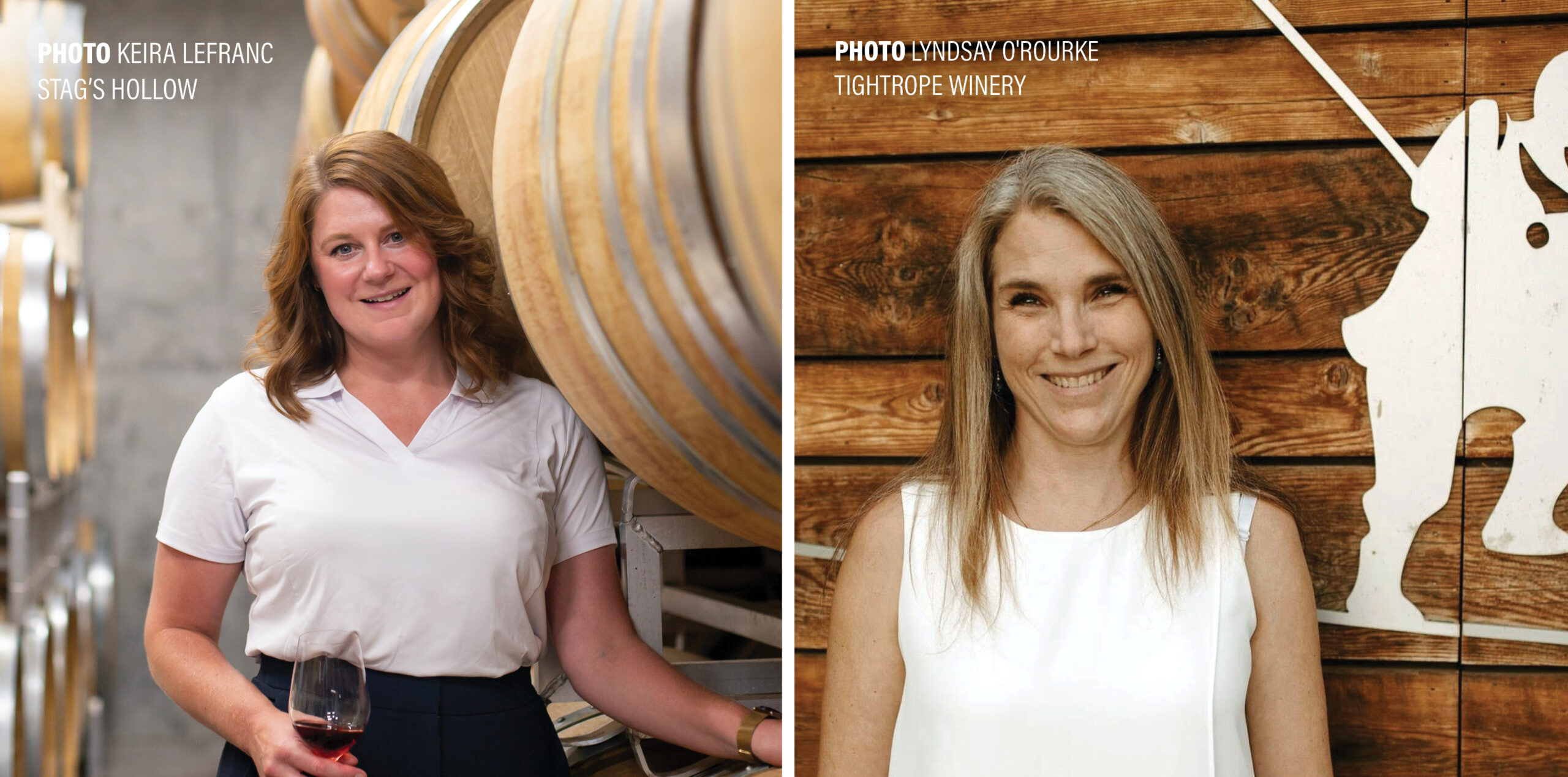
Keira LeFranc (Stag’s Hollow) grew up in Penticton and was studying science at the University of Alberta, with architecture in mind, when a summer job in Stag’s Hollow’s tasting room redirected her entirely. An invitation into the cellar led to her first harvest, then a move to Australia, a sommelier certification and a postgraduate diploma in Wine Science from the University of Auckland. She returned to B.C., stepped into Stag’s Hollow as Assistant Winemaker, and soon moved into the top role.
Lyndsay O’Rourke (Tightrope Winery) planned to take a year off university to snowboard in Whistler and stayed for 10 years. It was her mother, living in the Okanagan, who eventually suggested wine. She and her husband Graham enrolled at Lincoln University in New Zealand, where she earned a Bachelor of Viticulture and Oenology and Graham completed a postgraduate diploma. They returned home and founded Tightrope Winery on the Naramata Bench, with Graham managing the vines and Lyndsay in the cellar.
The Cellar as Laboratory
Different wineries, different portfolios, but a shared sensibility: restraint, site expression and fruit as the priority.
Keira works with an expansive range at Stag’s Hollow, from Pinot Noir and Chardonnay to Albariño, Tempranillo, Dolcetto, and Teroldego and has intentionally pulled back on oak across the board. “I want the vineyards to speak first,” she says. “I am continually striving for elegance over power.” Lyndsay keeps her hands equally light at Tightrope, her style shaped by time in New Zealand. “Our wines are fresh, clean, and reflect where they are grown as well as the variation of the vintage. My philosophy is minimal intervention, letting each variety express itself each year.”
A Region Under Pressure
Both have watched climate change reshape the Okanagan across the course of their careers, and neither is understating it.
Lyndsay has been making wine in B.C. for more than 20 years and has seen the summers grow steadily warmer and drier. Wildfire smoke taint has become a recurring and unsolved problem. The freeze of 2024, which caused widespread damage across the valley, was unlike anything the region had experienced in over 30 years. “The hope is that it is only a once-a-generation event,” she says.
Keira frames the challenge as one of ongoing variability rather than simple warming. In 10 years of winemaking, she cannot point to two identical vintages. “We are a small region without the economies of scale to homogenize dramatic vintage shifts,” she says. “We have to lean into vintage variation rather than fight it.” What gives her optimism is how B.C. producers are responding, refining styles toward natural acidity and freshness, and replanting with future conditions in mind.
Representation, Still in Progress
The Okanagan is frequently cited as having one of the highest percentages of female head winemakers of any wine region in the world. Both acknowledge the progress and keep going.
Keira wants young women with STEM interests to see winemaking as a viable path, not something they fall into by accident as she did. Lyndsay calls for broader representation in upper management and adds a pointed observation: “I might be biased, but I have to say most of my favourite wines are made by women.”
What B.C. Wine Is Becoming
Ask both where the region is heading and their answers land in the same place: the Okanagan’s greatest asset is its refusal to imitate.
The combination of latitude, desert-influenced climate and dramatic site diversity within a small geographic area produces wines with natural acidity, brightness and structural tension that belong to this place specifically. The region is still young, its identity still forming, and both winemakers see that as an advantage. “We are adaptable, innovative, and unafraid to evolve,” Keira says. “The next decade will be about refinement: defining what we do best and doing it exceptionally well.”