
Words Kenny Podmore, Centennial Coordinator Branch 37
Royal Canadian Legion Saanich Peninsula and Rhonda Todrick
In recognition of the Royal Canadian Legion’s 100th anniversary, it is our honour to share with you the stories of two Saanich Peninsula Cold War Veterans. The call to serve your country is the highest honour and responding to that call is a selfless act.
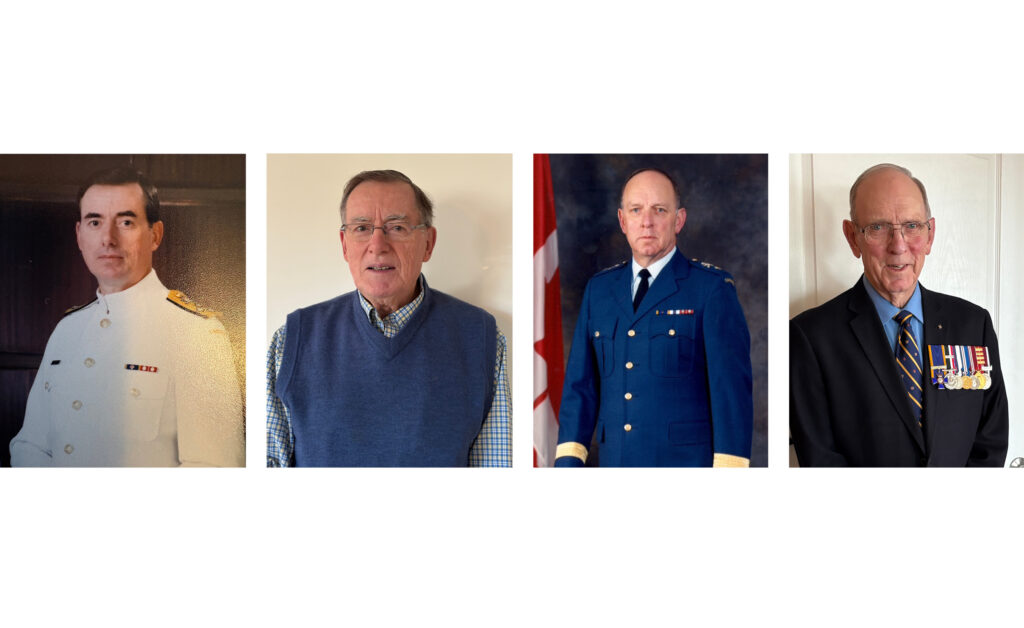
Admiral John Rogers Anderson CMM, CD (at left), was the 23rd Commander of the Canadian Navy and is the Honourary President of the Royal Canadian Naval Association.
Admiral Anderson joined the Royal Canadian Navy (RCN) as a Cadet in 1959 and studied at the University of British Columbia. From 1963 to 1966 he served: in HMCS Stadacona, HMCS Saskatchewan and HMCS St. Croix; and at HMCS Venture (Naval Officers Training Centre).
In 1966, Admiral Anderson specialized in operations, taking the Long Operations Course at HMCS Stadacona. He was appointed to the aircraft carrier HMCS Bonaventure in 1968. In 1970, he joined the CCS 280 Programming Team as a Programmer at Canadian Forces Headquarters (CFHQ) in Ottawa and in 1974, he became Executive Officer in the destroyer HMCS Iroquois. In 1975, he studied at the Canadian Forces Command and Staff College in Toronto and was promoted to Commander in 1976. He served at National Defence Headquarters (NDHQ) as the Section Head of the National Defence Operations Centre. In 1978, Anderson assumed command of the Esquimalt based destroyer-escort HMCS Restigouche and in 1980, he was named Commandant of the Naval Officers Training Centre Venture.
On promotion to Captain(N) in 1982, he was appointed Commander of the First Canadian Destroyer Squadron in Halifax, Nova Scotia. In 1983, he became Director Maritime Requirements (Sea) at NDHQ. Promoted to Commodore in 1986, Anderson was appointed Director General Maritime Doctrine and Operations at NDHQ. In July 1987, he was promoted to Rear-Admiral and was tasked to head the Canadian Nuclear Submarine Acquisition Project as the Chief of Submarine Acquisition. In July 1989, he was appointed Chief of Maritime Doctrine and Operations. On promotion to Vice-Admiral in July 1991, he was appointed the Commander Maritime Command in Halifax. The next year, he was made Vice Chief of the Defence Staff at NDHQ. Promoted to Admiral in January 1993, Admiral Anderson was appointed Chief of the Defence Staff. He served in this position until he retired in December 1993.
On departure from the Royal Canadian Navy, he took up his appointment as Canada’s Permanent Representative to NATO’s North Atlantic Council in the rank of Ambassador in Brussels, Belgium. On completion of this duty and after 37 years of service to his country John and his wife, Anne, returned to B.C. and took up residence in North Saanich, eventually settling in Sidney.
Born in Winnipeg, Manitoba, Brigadier-General Don Macnamara (Ret’d) (at right) is a graduate of the University of Western Ontario (B.A.) and the University of Toronto (M.A.), a Distinguished Graduate of both the Canadian Forces Staff School and the Canadian Forces Staff College and also attended the National Defence College. He spent the first half of a 37-year career in the RCAF and Canadian Armed Forces, starting as an Air Traffic Control Officer and then as a bio scientist in operations research and development in the areas of flight safety, environmental protection and weapons effects, which included service in the U.S, the U.K. and Germany and command of a research and development unit in Toronto. The latter half of his career, in strategic analysis, strategic intelligence and policy planning and professional education, included appointments as Director, Strategic Policy Planning and Director, Arms Control Policy in NDHQ, and as Director at both the Canadian Forces Command and Staff College and the National Defence College, where he was responsible for the curricula in strategic studies and international affairs.
A small sampling of his career highlights include:
He retired from the Canadian Forces in 1988 in the rank of Brigadier-General, and joined the faculty of the School of Business at Queen’s University to teach international business and strategy. He also taught a course in Canadian Foreign and Defence Policy in the Department of Political Studies. For four summers commencing in 1990, he was a Visiting Professor in International Management at the Universitat Kaiserslautern, Germany.
From 1984, he was first a Faculty Associate and then Senior Fellow in the Queen’s Centre for International Relations. In 1994-95, he served as a facilitator for and advisor to the Officer Development Board and to committees associated with the creation of the new National Security Studies Program and contributed to the academic accreditation of the various courses at the Canadian Forces College for graduate degrees.
Appointed Officer in the Order of Military Merit in 1978, BGen Macnamara was the co-recipient of the School of Business Scholars of Excellence Award in 1989, received the Commerce Society Award for Teaching Excellence in 1990, and was made a Paul Harris Fellow by Rotary International in 1994. For eight years, he was President of the Canadian Institute of Strategic Studies, of which he was a founding member, and led the establishment of the Lester B. Pearson Canadian International Peacekeeping Centre. He was a long-standing member of the Canadian Institute of International Affairs and last Chair of the Canadian Institute of Strategic Studies. He has been a member of the International Institute of Strategic Studies since 1974.
In 1996, Macnamara was appointed the first Honourary Colonel of the Canadian Forces College, a position he held for 15 years. In 2001, he was awarded a Chief of Defence Staff Commendation, and in 2002 received a Doctor of Military Science from the Royal Military College of Canada. In 2005, he received a Distinguished Service Award from the Queen’s Theological College, in 2011 the Canadian Forces Decoration Fourth Clasp, in 2012 the Canadian Forces Medallion for Distingushed Service and in 2013 the prestigious Vimy Award in recognition of his outstanding contribution to Canada’s defence and security. He is the recipient of the Queen Elizabeth the Second Silver, Gold and Diamond Jubilee Medals. Mcnamara also served as Chair of the Board of Governors of the Royal Military College of Canada and was a 14-year member of the RCAF Commander’s Council.
He and his wife Lee, together since 1956, now live in Sidney.
Clearly, the lives of our Cold War veterans were dedicated to excellence and their careers an example of what a “duty to serve” provides our country. We are so honoured and proud to have them living in our community. God Bless Canada.
Note: The Royal Canadian Legion’s Centennial Hangar Dinner & Dance is taking place June 20, 5 p.m. at the B.C. Aviation Museum.
For tickets, visit https://tinyurl.com/38c9n87s or call 250-656-2428.
Photos courtesy of John Rogers Anderson and Don Macnamara.