Words Cassidy Nunn
Photos Nunn Other Photography
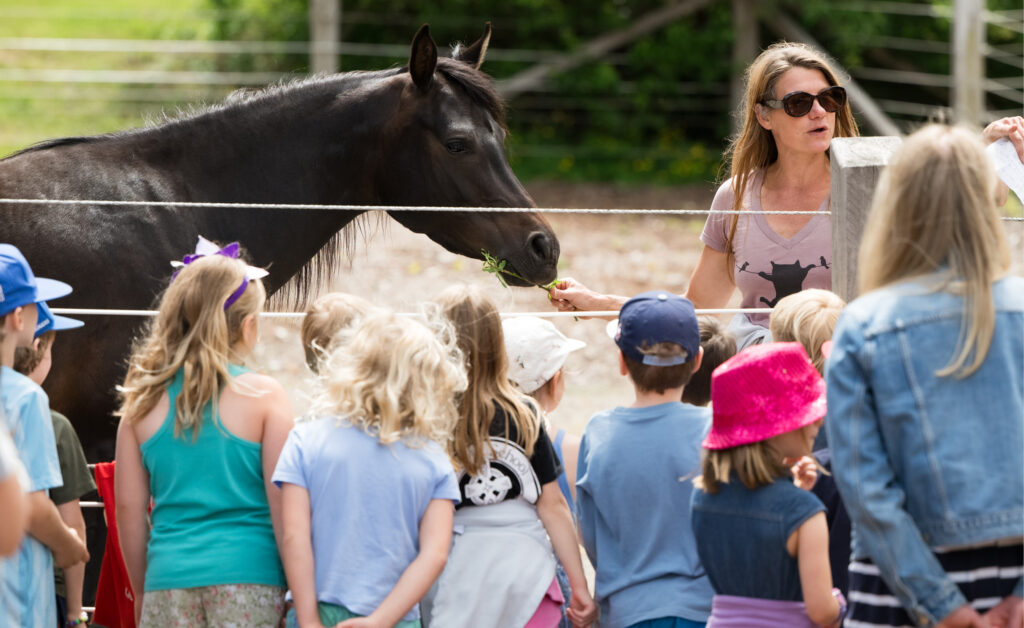
Suddenly, the horses’ ears all swivel attentively as they turn their heads to the steep slope parallel to the paddock. Their nostrils flare and a couple wander towards the fence line, eager to greet their guests. A long string of children march down the hill in line behind their teachers, Nadine MacIntyre’s grade one class and Erin Hill’s kindergarten class, on their way for a visit from their nearby school, Deep Cove Elementary. The group is here to visit the North Saanich Arabian breeding farm, Island Arabians, owned by Don and Ruth James, and to learn all about horses from the farm’s caretaker, Ann. The kids chatter excitedly and the horses continue to observe, attentive and curious. The teachers usher the kids into a lineup on one side of the fence and Ann, positioned in the paddock with the horses, steps forward and welcomes them with a warm smile. One of the horses sidles up beside her as if on cue and snuffles her hair.
Six years ago, Don and Ruth graciously opened up their acreage to classes at Deep Cove Elementary for the kids to have the opportunity for weekly outdoor learning and play time. The children build forts in the forest, create fairy houses in the woods, braid daisy chains and enjoy the outdoors in a creative, unstructured manner. Ann, who was the caretaker for the horses at the time, saw an opportunity to connect with the teachers and organize visits to the farm to meet the horses and allow the kids time to ask questions and interact with the herd. The teachers were on board, as were the James’, and ever since the classes have been coming in the spring time to visit the horses, feed them and ask any questions they have. A few of the children’s parents have come along as chaperones and the entire group seems enthralled by the herd as they pepper Ann with questions. First, Ann shows them how to greet the horses with a “horse handshake” as she calls it, turning her hand into a fist and holding it out towards the horse’s nose, while waiting for the horse to decide if he wants to come and smell her hand. She talks about consent and how we don’t just touch the horse without asking first – this small gesture is the way to ask if the horse is OK with being touched – and how we also have to honour the horse’s “no” if that’s what they communicate. The horse bumps her fist with his nose in greeting and Ann moves her hand to scratch his neck. The horse’s head moves up and down, mane tossing, enjoying the massage. The kids start raising their hands and asking questions:
“Do horses eat cheese?”
“No, horses are vegan!” replies Ann.
“How do horses sleep?”
“Horses have a hip lock mechanism which allows them to sleep standing up without falling over, but they also lie down to get their REM sleep. It’s really important for horses to lie down and sleep. They have to be comfortable and feeling safe,” says Ann.
“Do horses have two stomachs or four like cows? “
“Horses only have one and it’s 25 litres, which is why they’re always eating,” Ann says.
The curious inquiries continue and Ann reads off a sheet of additional questions the teacher had sent in ahead of time.
“Why is there straw in her tail?” “How do I know if they’re a girl or boy?” “How do you steer a horse?” “What if there was an earthquake?” “How high can a horse jump?” “How do you take the horses other places?”
Ann says, with equal enthusiasm to that of the kids: “I love the opportunity to learn and I love their questions – they come with the best questions!”
After all the questions, the students come to the fence line and offer the horses some food that Ann has prepared, wild foraged willow tree branches, dandelion leaves and flowers “so the students understand what horses are designed to eat,” she says. They practise their horse handshake and giggle and laugh as the animals engage with them, fingers tickled by the horse’s long whiskers. Nadine tells me how excited the students have been for this visit. “It’s nice to see how in time with the animals they observe and engage,” she says.
After saying a reluctant goodbye to the horses, the students and their teachers trek back up the hill and through the forest. They check on the forts they’ve been building and run in the woods, collecting sticks and chattering excitedly about their experience and the next time they hope to visit the herd of Arabian horses.