
Words & Photos M. Honoré France
Musa Basjoon – a Treasure on the Shoreline
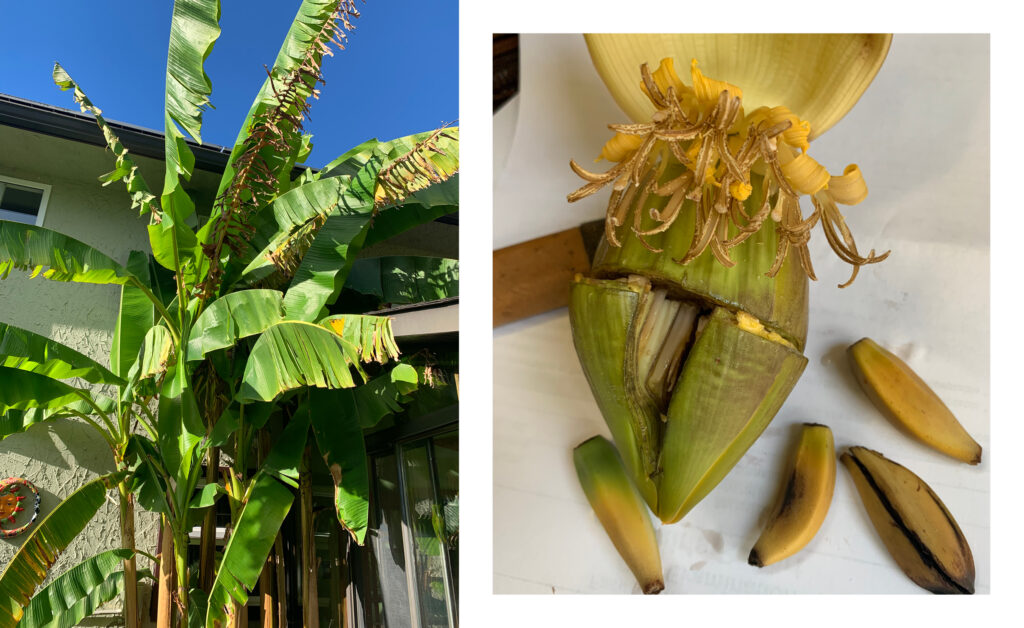
When I first saw a banana plant for sale, I had no idea about the various varieties, but it was interesting to imagine them growing in my yard. We had no snow the winter of 2026; none of my eight banana trees died, and one of them had bananas and a large flower (a pod).
The variety of bananas sold in Canada is called the Japanese fibre tree or – by its scientific name – Musa Basjoo. It is a useful plant that is grown across the world and used in a variety of ways. Its ornamental value is amazing because of its tropical beauty in gardens, but it is also useful as an important ingredient in pharmacology and in textiles.
The Compendium of Materia Medica, a medical book written 450 years ago, describes the various medical uses of Musa Basjoo. Traditional Chinese Medicine used it in treating health issues, including cerebral hemorrhage, urinary tract infection, various swelling and the common cold. In the modern world, medical literature describes hundreds of experiments and studies on the usefulness and efficacy of this plant in the treatment of illnesses.
The use of Musa Basjoo in textiles is documented as far back as the 13th century in Okinawa, Japan. China and the Philippines manufacture clothing from the banana and it is a valuable export. The fibres in the banana plant, taken from the trunk, is a breathable fabric, described as being like “the wings of a dragonfly.” It takes three years to process the thin cloth, from pruning to thread that is woven into cloth. In Japan, it is idolized as a textile used to make cloth that sells for thousands of dollars in the humid climate of Japan. The cloth is natural and organically grown, and is very different from cotton. The banana fibres are more comfortable than cotton and better for the environment. Musa Banjoo takes three months to weave a bolt of cloth from tree harvesting, using 60 trees for one bolt of cloth.
My experience in growing Musa Banjoo on Vancouver Island has been exhilarating; I like it because:
- It’s easy to maintain – you just need to water it and provide a little food;
- It provides the garden with a jungle look, with leaves that can be used as food containers;
- It’s hardy, growing in heat zones 5-10, and can produce bananas in 18th months;
- It grows in well-drained soil and, on average grows 1.8 to 8.5 metres tall;
- It isn’t like a tree (woody) but like a herb with a large stem that is layered, onion-like, and can produce magnificent leaves growing up to two metres long;
- It has a pod or flower that is layered full of sweet nodes that some Asia cuisines utilize; and
- Once the fruit is produced the visible part dies but continues as a “pups” (babies) regrowing in spring to maturity.
My short poem reflects my joy of having the Musa Basjoo in my garden:
Banana Tree, like a dragonfly
Haut fashion, good medicine, climate friendly
Nourishing the Spirit