
Words & Photos Cynthia Philp
Long ago, I learned that each planter must have a Thriller, a Filler and a Spiller, each preferably in odd numbers.
Recently, I’ve taken note of a new trend that has me rethinking those rules.
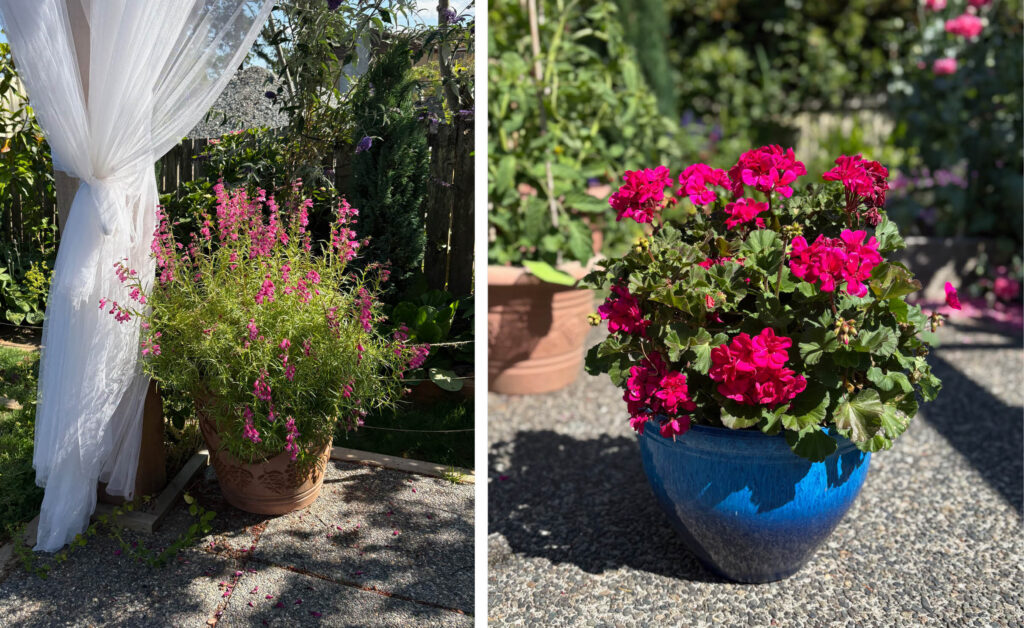
In advertisements and industry photos, planters and baskets are now often mono-botanic (a single type of plant). In the fashion industry, a rough styling comparison would be called colour-blocking, the goal of which is to avoid sharp contrasts to drive up impact.
When an entire countryside is crammed into one pot, the result can feel messy and unbalanced; competing plants often get lost in the mix. A mono-botanic planter is bold and simple, catching your attention at a distance.
Here’s a comparison:
Traditional: The thriller/filler/spiller guideline is a greenhouse mantra. The combination of something tall and dramatic, something full and rounded and something cascading over the edge is almost foolproof. But it can be tricky to find a combination that works well together. It’s also easy to accidentally combine plants with competing environmental needs. Salvia appreciates dryer conditions; petunias like consistent moisture. Putting them together means someone isn’t happy.
Mono-botanic: Pick one plant that suits the conditions you offer. Placing geraniums in a sunny spot and coleus in a shaded area helps ensure each will thrive.
Traditional: The Rule of Odd Numbers. The classic arrangement is one thriller (e.g. dracaena), three fillers (geraniums) and five spillers (ivy) in a standard 12-inch pot. For those who like to follow rules to the letter, this leads to mathematical quandaries when buying four-packs of annuals.
Mono-botanic: With all the same type of plant in a pot, there’s no need to count. You just add however many you need to fill in the planter. If you have an extra, tuck it in; it won’t look out of place.
This new way of planting benefits smaller gardens in many other ways. A smaller pot has a bigger impression: any colour stands out if there’s more of it and not offset by something else.
You can also grow larger specimens that don’t share space gracefully. Hydrangea and lavender easily grow on a balcony without looking squished if each has its own pot.
A gardener can still compose groupings by arranging the planters: one of mint (lots of water), one of rosemary (lots of sun) and one of basil (moderate water and sun) ensures each plant in your herb garden does well.
Note that colour blocking rules apply to the planters themselves: stick to one type for maximum impact.
Even though this is appearing as a new trend, the style is actually very old. A classic Italian garden will have a geranium in one container, a lemon in another and a basil in yet another.
Rarely will you see assorted plants tucked in, competing for nutrients.
To date, I have only been partially successful at transitioning my thinking. The temptation to “just tuck this in” with an orphaned plant is overwhelming. But where I have restrained myself, I am rewarded with something truly extraordinary. I’ve also found that I’ve purchased fewer annuals this year, and feel that my planters have higher impact.
Keep an eye out for mono-botanic plantings this summer, and see what you think.